
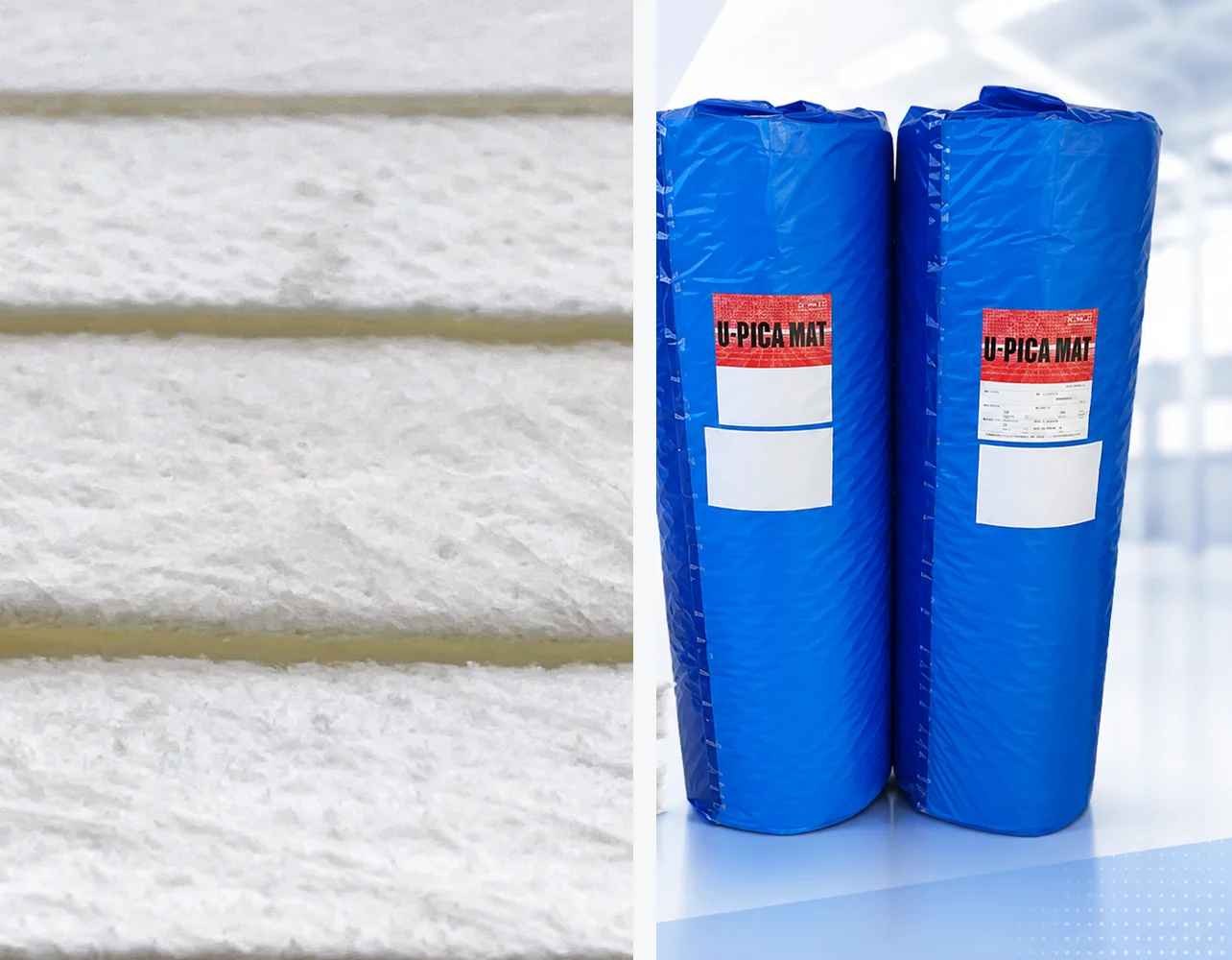
Thickness and stiffness without a matching increase in resin
U-PICA MAT has excellent wet-out with unsaturated polyester resin and absorbs about 55% by volume of resin. When properly impregnated, its thickness does not change after cure. Placed between glass layers, it forms a thick, light core that makes the laminate stiffer while using less glass and resin than a solid laminate of the same stiffness.
Applications
- Boats: hulls, decks, roofs and fittings
- Vehicles: spoilers, fenders, roofs, container panels
- Housing: bathroom units, water tanks, septic tanks, drain lids, floors, pools
- Feed tanks, crawls and FRP molds
Benefits
- Compared with solid FRP of the same flexural strength and stiffness: lighter laminate, much less resin and lower cost.
- Easily builds a thick core layer and greater stiffness – suited to thin, complex parts that need rigidity and light weight.
- Dramatically reduces print-through on the gelcoat surface, particularly with woven rovings.
- Lower exotherm, so thick laminates are easier to build; shorter laminating time.
- Light and easy to handle and cut; saves glass mat.
- Better thermal insulation than all-glass laminate thanks to the microballoons in the core.
- Approved by Lloyd's Register for marine applications.
Five standard thickness grades
| Property | T-1000 | T-2000 | T-3000 | T-4000 | T-5000 |
|---|---|---|---|---|---|
| Dry thickness (mm) | 1.6 | 2.1 | 3.1 | 4.1 | 5.1 |
| Wet thickness (mm) | 1.5 | 2.0 | 3.0 | 4.0 | 5.0 |
| Weight (g/m²) | 60 | 90 | 135 | 160 | 200 |
| Apparent density (g/cm³) | 0.040 | 0.045 | 0.045 | 0.040 | 0.040 |
| Resin absorption (vol.%) | 55 | 60 | 55 | 55 | 55 |
| Roll length (m) | 50 | 50 | 50 | 50 | 50 |
| Roll weight (kg) | ~4 | ~5 | ~7 | ~8 | ~10 |
Packaging: wound on a paper core, wrapped in polyethylene film. Soft S-type grades S-3000, S-4000 and S-5000 are also available on request.
Comparison with other core materials
| Core material | Density (g/cm³) | Tensile strength (MPa) | Compressive strength* (MPa) |
|---|---|---|---|
| U-PICA MAT – before molding | 0.045 | 1.18–1.96 | — |
| U-PICA MAT – after molding | 0.70–0.80 | 5.88–9.81 | 21.6 |
| Rigid polyurethane foam | 0.024–0.29 | 0.11–4.81 | 0.11–7.55 |
| PVC foam | 0.032–0.095 | 0.88–1.67 | 0.31–1.77 |
| Balsa (perpendicular to grain) | 0.096–0.248 | 9.32–30.4 | 5.10–22.6 |
* Compressive strength at 10% strain, per JIS K 6911.
Resin requirement
About 0.65 kg of resin per m² of U-PICA MAT per mm of thickness (compared with about 1 kg per m² per mm for glass mat laminate). Example: 3 m² of T-4000 (4 mm) needs 0.65 × 4 × 3 = 7.8 kg of resin. Under-impregnation will not reach the expected core thickness and stiffness.
How to laminate (hand lay-up, spray-up)
- T-1000, T-2000: apply 20–30% of the required resin to the bed mat, position U-PICA MAT, apply the remaining resin and roll out. Make sure there are no voids between U-PICA MAT and the bed mat.
- T-3000, T-4000, T-5000: apply half of the required resin to the underside and the other half to the top side of U-PICA MAT, then roll out. Full wet-out is essential.
- Vertical mold surfaces: apply about 10% of the resin to the mold, pre-impregnate 60–70% into U-PICA MAT, position it, then apply the rest and roll out.
- Joints: butt-joint the sheets – no overlap needed. Fill any gap wider than 2 mm with a strip of U-PICA MAT cut with a knife or scissors.
Design notes
- Do not use U-PICA MAT as a layer carrying direct tensile stress; where some stress occurs, use a sandwich construction with glass layers on both sides.
- For corrosion-resistant products, avoid exposing the U-PICA MAT layer directly to corrosive media.
Storage
Keep dry in the original packaging, in a well-ventilated place away from direct sunlight. Store rolls vertically – horizontal storage or stacking may affect thickness. Avoid direct contact with raw catalysts. Store below 40°C and below 60% relative humidity.
Frequently asked questions
Which U-PICA MAT grade should I use?
By the core thickness needed after cure: T-1000 about 1 mm, T-2000 about 2 mm, T-3000 about 3 mm, T-4000 about 4 mm, T-5000 about 5 mm.
How much resin does U-PICA MAT need?
About 0.65 kg per m² per mm of thickness. For example, 3 m² of T-4000 needs about 7.8 kg of resin.
Which processes is U-PICA MAT for?
Hand lay-up and spray-up, handled the same way as glass mat or woven roving.
Do sheets need to overlap?
No. Butt-joint the sheets; fill gaps wider than 2 mm with a strip of U-PICA MAT.
Does U-PICA MAT reduce print-through?
Yes. It dramatically reduces print-through on the gelcoat surface, especially in laminates with woven roving.
How should U-PICA MAT be stored?
Dry in original packaging, rolls standing vertically, away from sunlight, below 40°C and 60% RH.
Select the grade by the core thickness required and the laminate construction. Trial on a sample part with your resin and process before production.