
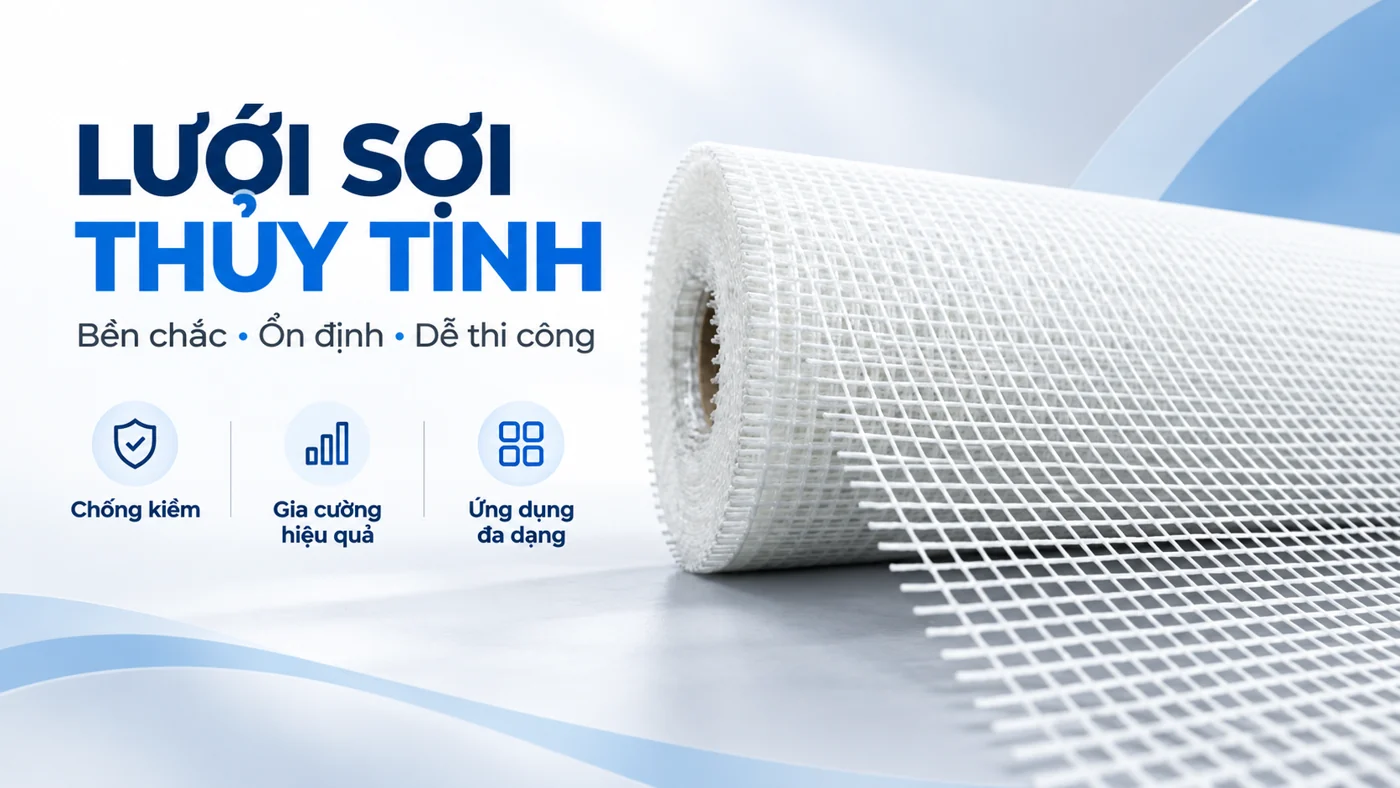
Reinforcement for crack control and waterproofing
Fiberglass mesh is embedded in render to reinforce the surface and limit wall cracking caused by shrinkage or vibration. With liquid waterproofing, the mesh lets the coating pass through, forming a reinforced membrane that withstands forces between the top and bottom layers. It is also used in FRP composite waterproofing overlays.
Applications
- Render reinforcement against wall cracking
- Roof and bathroom waterproofing with liquid membranes
- Pool and tank corner detailing with FRP composite
- Crack control on gypsum board joints and wall base corners
- Exterior insulation finishing systems (EIFS) – AR line
Alkali-resistant mesh: two options
In cement render and concrete, the alkaline environment can degrade ordinary glass fiber over time. GKFRP supplies two types of alkali-resistant mesh:
- AR-glass mesh: woven from alkali-resistant glass fiber with ZrO₂ (zirconia) ≥ 16.5% in the glass composition itself. Alkali resistance comes from the fiber, not from a coating – suited to long-term reinforcement of cement render and concrete. See also AR alkali-resistant glass fiber.
- Alkali-resistant coated E-glass mesh: E-glass coated with an alkali-resistant polymer latex that withstands the alkalinity of render and base coats, with good dimensional stability, low shrinkage and water resistance. An economical choice for crack control, waterproofing and EIFS.
Weights and mesh sizes for each type are available on request.
Specifications – M145-5×5 mesh
| Property | Test method | Value |
|---|---|---|
| Fabric weight | GB/T 7689.2-2001 | 125 g/m² ± 5% |
| Coating weight | GB/T 7689.3-2001 | 20 g/m² ± 5% |
| Warp count | GB/T 7689.4-2001 | 20 ± 1 ends / 10 cm |
| Weft count | GB/T 7689.4-2001 | 19 ± 1 ends / 10 cm |
| Mesh size | — | 5.0 × 5.0 mm |
Other specifications (weight, mesh size) are available on request.
Choosing mesh weight
Mesh weight depends on render thickness: thicker render calls for heavier mesh, thinner render for lighter mesh.
Installing mesh for crack control
- Base coat: after building the rough wall, apply a thin render coat of about 1–3 mm, enough to cover the brick surface.
- Lay the mesh: while the base coat is still wet, lay the mesh from top to bottom and press it into the render. Overlap each sheet on the previous one by at least 10 cm.
- Finish coat: apply the second render coat over the mesh and level it with a trowel and float. Avoid disturbing the wall while wet to prevent cracks or air bubbles.
Storage
Store in a cool, dry place at 10–30°C and 50–75% relative humidity. Keep the mesh in its packaging until just before use.
Frequently asked questions
What is the weight of M145-5×5 mesh?
145 g/m²: 125 g/m² fabric plus 20 g/m² coating, ± 5%. Mesh openings are 5 × 5 mm.
How much overlap is needed?
Overlap each sheet on the previous one by at least 10 cm.
When should the mesh be laid?
Press the mesh into the first render coat while still wet, then apply the finish coat over it.
Can the mesh be used with liquid waterproofing?
Yes. The mesh lets liquid waterproofing pass through, forming a reinforced membrane at locations with frequent movement such as roofs, bathrooms and tank corners.
Is alkali-resistant mesh available?
Two types: AR-glass mesh woven from fiber with ZrO₂ ≥ 16.5% for long-term reinforcement of cement render and concrete, and E-glass mesh with an alkali-resistant polymer latex coating, an economical choice for crack control, waterproofing and EIFS. Specifications on request.
Are other mesh specifications available?
Yes. Other weights and mesh sizes are available on request, selected by render thickness and application.
How should the mesh be stored?
In a cool, dry place at 10–30°C and 50–75% RH; keep in packaging until use.
Select mesh weight to suit render thickness and the waterproofing system. Trial on a small area before full-scale application.