
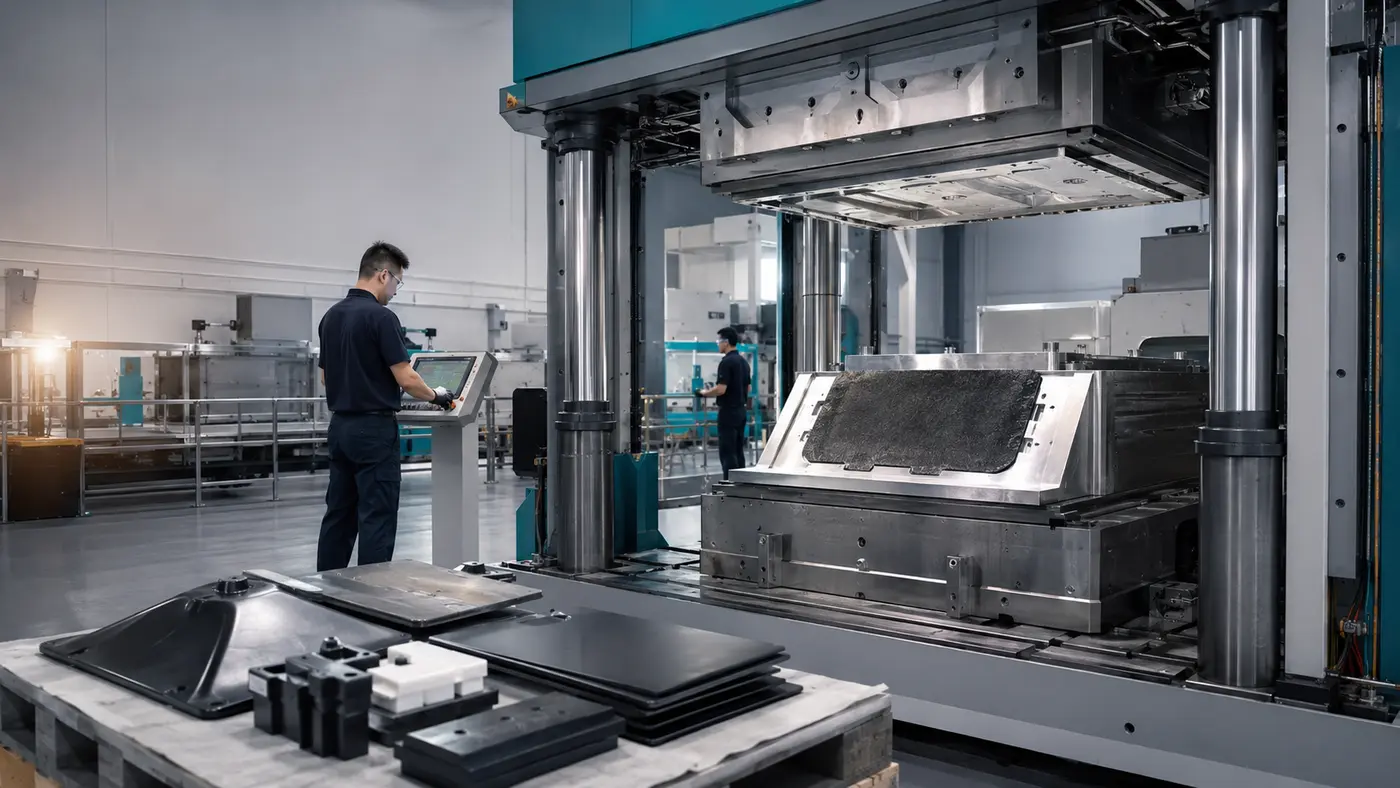
What are SMC and BMC?
SMC – Sheet Molding Compound is a thermoset composite supplied as a sheet. Resin, fillers, additives and curing agents are combined with chopped reinforcement to create a compound with suitable flow and maturation for compression molding. During production, a measured quantity of SMC is cut into a charge, positioned in a heated mold and compressed so the material flows to fill the cavity.
BMC – Bulk Molding Compound uses a similar materials concept but is supplied as a bulk or dough-like compound rather than a sheet. BMC usually contains shorter reinforcement than SMC and can flow into smaller features, ribs, bosses and more intricate geometries. It is therefore often selected for small-to-medium technical parts requiring good mold fill and dimensional repeatability.
What is inside an SMC/BMC compound?
A typical SMC/BMC formulation includes a thermoset resin matrix, chopped glass reinforcement, mineral fillers, curing agents, thickeners, pigments, internal mold release and additives used to control shrinkage, flow or surface quality. Exact formulations vary widely depending on requirements such as mechanical performance, flame retardancy, electrical insulation, Class A appearance, dimensional stability or cost.
The compound should not be judged by fiber content alone. Maturation, viscosity, fiber length, fiber dispersion, filler loading and storage condition all influence flow, mold filling and final mechanical properties.
Main differences between SMC and BMC
| Criterion | SMC | BMC |
|---|---|---|
| Material form | Sheet compound | Bulk/dough-like compound |
| Reinforcement | Typically longer chopped fiber | Typically shorter chopped fiber |
| Flow behavior | Well suited to panels and larger parts | Good for small features, ribs, bosses and complex geometry |
| Typical applications | Panels, covers, structural parts, automotive and electrical components | Housings, electrical parts, technical components and precision molded parts |
| Design priority | Balance flow and fiber orientation | Fill detail while controlling shrinkage |
SMC/BMC compression molding process
The process begins by defining the correct charge weight. SMC is cut and stacked in a planned pattern, while BMC is portioned into a suitable charge. The charge is placed in the heated mold and the tool closes at a controlled speed. Under pressure and temperature, the compound flows to fill the cavity while the thermoset curing reaction progresses.
Once the required cure is reached, the mold opens and the part is removed. Flash is trimmed, the surface is inspected and the molded part may proceed to drilling, insert installation, painting or bonding where the material system and release chemistry permit.
Key process controls
Mold temperature must be high enough to activate cure, but not so high that the material cures before the cavity is completely filled. Compression pressure must compact the charge and drive flow to end-of-fill regions, while excessive pressure can increase flash or promote phase separation.
Mold closing speed strongly affects flow pattern and fiber orientation. Cure time must match part thickness, compound chemistry and mold temperature. Charge weight, charge position, storage time, storage condition and lot-to-lot consistency should also be controlled.
Role of mold release
SMC/BMC may use internal release agents, external mold release or a combination of both. The selected system should provide stable demolding without excessive buildup, loss of surface quality or interference with painting, printing or bonding downstream.
Release selection should consider mold substrate, mold temperature, compound type, surface requirement, number of cycles between cleaning and post-processing needs. Where painting or adhesive bonding is required, compatibility should be confirmed on the actual production process before full-scale use.
Common SMC/BMC molding defects
- Short shot: insufficient charge, poor charge placement or inadequate flow to the end of the cavity.
- Flow marks: non-uniform material flow, unsuitable closing speed or mold temperature.
- Voids: trapped air, moisture, unstable compound condition or unsuitable molding parameters.
- Excessive flash: too much charge, mold-gap issues or excessive pressure.
- Warp or uneven shrinkage: non-uniform material distribution, mold temperature imbalance or an unsuitable low-profile system.
- Mold sticking: mold surface condition, release system or maintenance interval is not suitable.
- Fiber read-through / poor surface: excessive flow, insufficient resin-rich surface or an unsuitable cure condition.
Applications of SMC and BMC
SMC and BMC are widely used in electrical equipment, switchgear, insulating components, panels, technical covers, automotive parts, appliance components, water-tank panels and many other industrial products produced at scale. A major advantage is the ability to create near-net-shape parts in a single molding cycle while maintaining good dimensional repeatability when both the compound and the process are controlled.
Production checklist
- Confirm the correct SMC/BMC grade for mechanical, thermal, electrical and flame-retardant requirements.
- Verify compound storage conditions and material condition before molding.
- Define charge weight and charge position for the part geometry.
- Set mold temperature, pressure, closing speed and cure time.
- Evaluate release chemistry together with painting or bonding requirements.
- Track flash, surface quality, dimensions and scrap rate during production.