
How carbon fiber works in a composite
In CFRP, carbon fiber is the primary load-carrying reinforcement while the polymer matrix holds the fibers in position, transfers load between them and protects the reinforcement. The key point is that laminate properties are strongly directional: a ply carries load most efficiently along the fiber direction, so the stacking sequence directly affects tensile, bending, torsional and multi-directional performance.
A carbon laminate should not be judged only by its black color, gloss or attractive weave. A visually perfect twill surface can still be structurally unsuitable if fiber directions and ply count do not match the actual load case.
Common carbon reinforcement forms
- UD – unidirectional: most fibers run in one direction. Useful when stiffness and strength are required primarily along one load path.
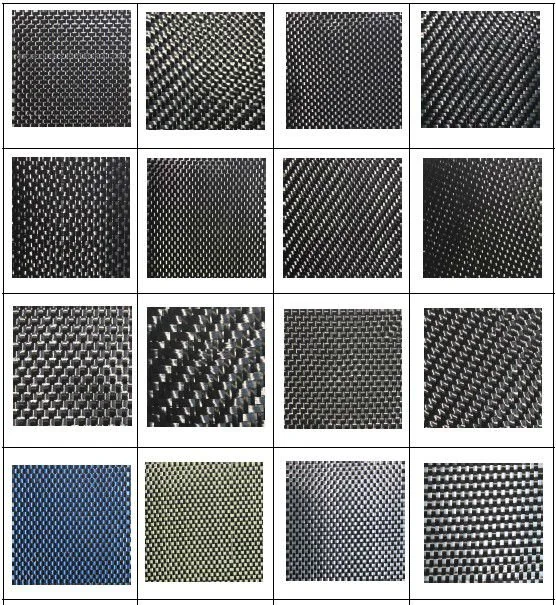
- 0/90 woven fabric: warp and weft yarns are woven at right angles, providing reinforcement in two principal directions.
- Twill: offers good drapeability and a distinctive cosmetic pattern, often useful on curved surfaces.
- Satin: has fewer interlacings, typically giving lower crimp and good drape over complex geometry, but it can require more care during handling.
- Multiaxial / NCF: several fiber directions are stitched together rather than interlaced in a conventional weave, reducing crimp and allowing multiple orientations to be placed in one operation.
- Braided reinforcement: useful for tubular, profile and circumferentially reinforced structures.
Plain, twill or satin?
Weave style affects crimp, drapeability and handling stability. Plain weave locks the yarns firmly but creates more fiber undulation. Twill provides a practical balance between stability, drape and appearance. Satin uses fewer crossover points, so the yarns remain straighter and the fabric generally conforms well to complex shapes, although it can distort more easily during handling.
The weave should therefore be selected based on mold geometry, mechanical requirements, cutting and lay-up stability, and surface expectations rather than appearance alone.
What do 3K, 6K and 12K mean?
K indicates the approximate filament count in one tow: 3K is about 3,000 filaments, 6K about 6,000 and 12K about 12,000. Smaller tows can support fine cosmetic fabrics and low areal weights, while larger tows can build higher areal weight efficiently. Tow size alone does not determine laminate quality; it must be considered together with fiber grade, weave, fabric areal weight, resin impregnation and structural requirements.
Fiber orientation matters more than appearance
A multi-ply laminate often combines 0°, 90° and ±45° plies depending on the load case. The 0° direction primarily supports longitudinal loads, 90° supports transverse loads, and ±45° plies are commonly used to improve shear and torsional response. The proportion of each orientation must follow the real loading of the part rather than a copied lay-up from another application.
For safety-critical parts, laminate analysis or physical validation is required. This article is intended as a practical material and process selection guide, not as a structural design calculation.
Resin content and void control
Carbon composite performance does not come from the fiber alone. A resin-rich laminate adds mass without a proportional gain in stiffness. Poor wet-out or trapped air can create voids that reduce laminate consistency and affect surface quality.
For wet lay-up and vacuum bagging, resin quantity, wet-out sequence, consolidation/debulk and vacuum quality should be controlled. In vacuum infusion or RTM, fabric permeability, flow path, inlet/vacuum layout and dry-spot risk must be considered. With prepreg, temperature, pressure and cure cycle must follow the resin system requirements.
Carbon for cosmetic surfaces
When carbon is left visible, twill or visually uniform fabrics are often selected for appearance. A cosmetic weave, however, does not replace structural reinforcement design. Where mechanical performance is the priority, UD, NCF or a hybrid lay-up may be needed, while the decorative woven carbon becomes only the outer ply.
Carbon is electrically conductive, so when it is bonded directly to metals, especially in wet or electrolytic environments, suitable electrical isolation should be considered.
A practical selection sequence
When choosing a carbon reinforcement, define:
- Main loads: tension, bending, torsion, impact or multi-axial loading.
- Mold geometry: flat, large-radius curves, tight corners or complex shapes.
- Process: wet lay-up, vacuum bagging, infusion, RTM or prepreg.
- Surface requirement: structural-only or exposed cosmetic carbon.
- Fabric areal weight and target laminate thickness.
- Compatibility with the resin system and cure conditions.
Practical examples
A thin decorative carbon panel may favor a 3K twill because of appearance and handling. A beam carrying mainly longitudinal bending loads usually needs a high proportion of 0° reinforcement and may combine UD with ±45° plies for shear and torsional stability. A complex curved shell may benefit from twill, satin or a lighter fabric that conforms more easily to the mold.
There is no single carbon fabric that is optimal for every application. Correct selection starts with the load path, geometry and manufacturing process.
Carbon materials from GKFRP
GKFRP supplies 3K carbon fabrics in plain and twill constructions together with related composite reinforcements. For selection support, provide the part geometry, dimensions, process, resin system and performance requirements.