
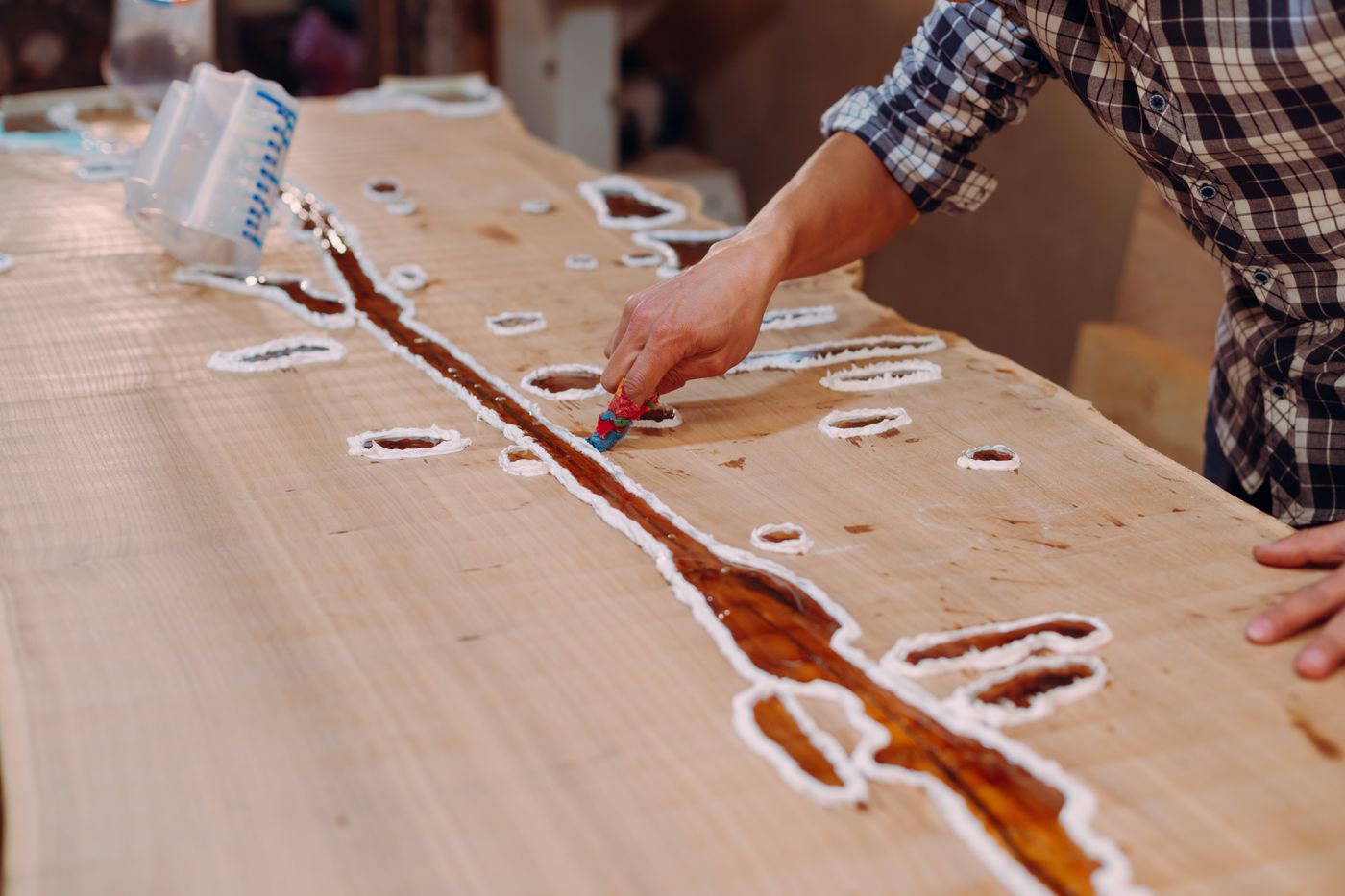
What is a River Table?
A River Table uses two or more pieces of natural wood with epoxy cast into the gap between them. The epoxy may be crystal clear, translucent, metallic, pearlescent or tinted in many different ways.
After full cure, the wood and epoxy are machined, sanded and polished into a single finished surface.
Not every epoxy is suitable for River Tables
Epoxy releases heat while resin and hardener react. In larger pours, that heat can build up inside the casting.
If a fast-curing or coating-grade epoxy is poured too thick, the result can be excessive heat, bubbles, cracking, shrinkage, discoloration, surface distortion or uncontrolled cure speed.
What is Deep Pour Epoxy?
Deep Pour Epoxy is a two-part system consisting of Part A resin and Part B hardener, formulated for thicker castings and longer working time than typical surface coatings.

A suitable River Table system typically requires high clarity, workable viscosity, long pot life, controlled exotherm, low shrinkage, suitable hardness and good resistance to yellowing.
Deep Pour Epoxy vs. Epoxy Coating
| Property | Deep Pour Epoxy | Epoxy Coating |
|---|---|---|
| Main use | River Tables, wood casting, thick pours | Surface coating |
| Typical thickness | Designed for thicker pours | Usually thin layers |
| Cure speed | Typically slower | Typically faster |
| Pot life | Typically longer | Typically shorter |
| Design priority | Heat control during casting | Surface build and finish |
Important: these are general tendencies. Maximum pour depth and process limits must be confirmed from the TDS of the actual epoxy system.
Wood preparation before casting
Wet wood or poorly prepared surfaces can cause bubbling, weak adhesion, cracking or gaps between the wood and cured epoxy. Before pouring, check moisture, clean the surface, remove weak fibers and seal porous areas when needed.
Basic River Table process
- Prepare the wood: use properly dried and dimensionally stable timber.
- Prepare the surface: sand, clean and remove loose or weak wood.
- Build the mold: it must be flat, rigid, leak-tight and properly released.
- Seal the wood: reduce air release from pores and deep grain.
- Mix epoxy: follow the specified resin-to-hardener ratio exactly.
- Add color: use pigments compatible with epoxy.
- Pour: stay within the recommended casting depth and process window.
- Cure: keep ambient conditions stable.
- Finish: demold, machine, sand and polish only after full cure.
Where do bubbles come from?
Bubbles can be introduced during mixing, released from porous wood, trapped in deep cracks, caused by high resin viscosity, poor temperature control or improper pigment mixing.
For this reason, mixing technique, viscosity and process conditions matter just as much as the resin formulation itself.
How thick can one pour be?
There is no single thickness that applies to all Deep Pour Epoxies. Maximum pour depth depends on formulation, hardener type, part geometry, total resin mass, ambient temperature, mold design and heat dissipation.
Always confirm the limit from the TDS of the exact grade being used.
Applications beyond River Tables
Deep Pour Epoxy can also be used for coffee tables, console tables, countertops, wood slabs, decorative panels, resin art, botanical castings and other furniture or decorative objects.
Key data to check when selecting epoxy
- Mixing ratio
- Mixed viscosity
- Pot life and gel time
- Full cure time
- Maximum casting thickness
- Peak exotherm
- Shore hardness
- UV / yellowing resistance
- Shrinkage
- Adhesion to wood