
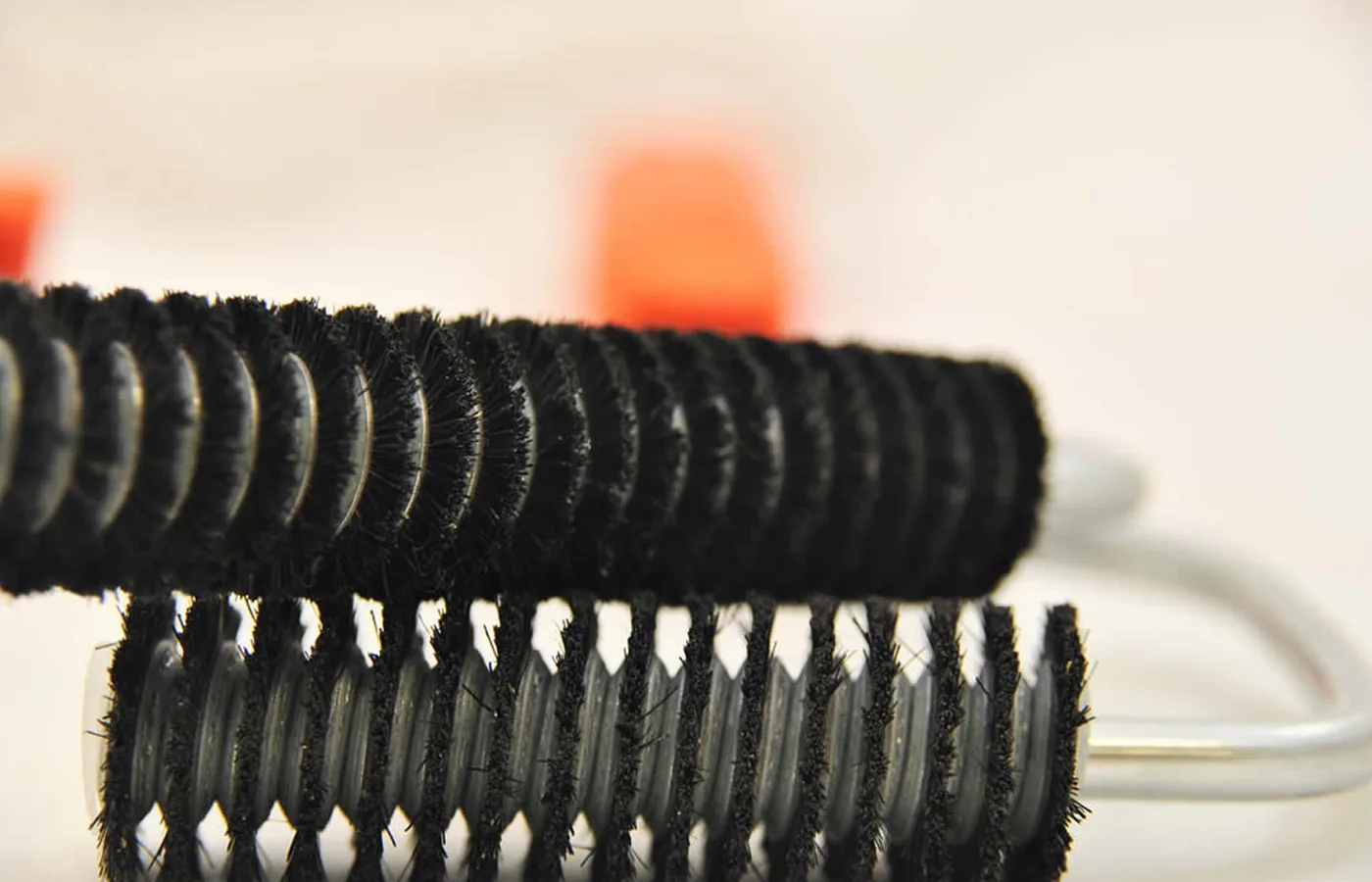
What a roller does in hand lay-up
After the reinforcement is wetted with resin, the roller presses fibers against the mold, spreads resin evenly and pushes air out of the laminate. Trapped air creates voids, lowers mechanical properties and can cause blisters or print-through on the gelcoat. A roller cannot replace proper wet-out: rolling over dry fiber only moves the air somewhere else.
Common roller types
| Type | Characteristics | Best for |
|---|---|---|
| Aluminum ribbed roller | Circular ribs, good consolidation force | Flat or large curved surfaces, CSM, woven roving |
| Aluminum spiral roller | Spiral ribs push air to both sides | Thick laminates, large areas |
| Paddle roller | Paddles along the axis, fast resin spreading | Large areas needing fast wet-out and air removal |
| Corner roller | Narrow head, small diameter | Corners, edges, ribs, tight radii |
| Nylon bristle roller | Nylon bristle rings, soft contact | Thin plies, surface mat, curved surfaces |
Match the part geometry
Large, fairly flat surfaces call for longer rollers to work faster. Corners, ribs and recesses need a corner roller or a short, small-diameter head to consolidate right into the radius and avoid fiber bridging. On tight curves and detailed molds, a bristle roller follows the contour better than a rigid metal roller.
Match the reinforcement
CSM needs enough pressure for full wet-out and air release. Woven roving and technical fabrics need moderate pressure, rolled along the fiber direction so the weave and edges are not distorted. Surface mat and thin plies are best consolidated with a bristle roller.
Rolling technique
- Work outward from wetted areas into unfinished areas, from the center to the edges, so no new air pockets form.
- Use just enough pressure; excessive force pushes resin away and shifts fibers.
- Inspect for white (dry) fiber and bubbles under raking light.
- Finish rolling before the resin starts to gel.
Cleaning and storage
Clean rollers immediately after use, before resin cures in the ribs, with a compatible solvent and following shop safety procedures. Cured resin in the ribs or between bristle rings reduces rolling performance next time.