
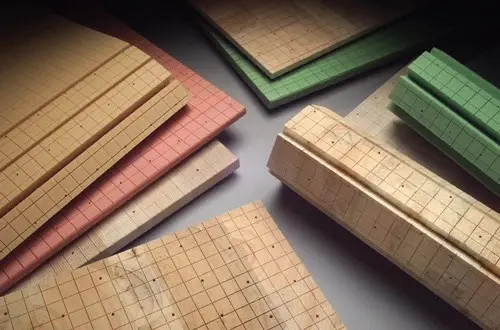
What does a core material do in a composite structure?
In a sandwich structure, the two skins carry most of the tensile and compressive stress during bending, while the core keeps the skins separated and transfers shear. Increasing the distance between the skins greatly increases the section moment of inertia, which can raise bending stiffness substantially without a proportional increase in weight.
A core is therefore more than a filler. It directly influences stiffness, compressive and shear performance, surface stability, mass, temperature capability, fatigue behavior and manufacturing method. The bond between the skins and the core is just as important as the core material itself.
Common composite core material families
PVC foam
PVC foam is one of the most widely used structural core materials in industrial and marine composites. It offers a practical balance of low density, stiffness, compressive performance, machinability and compatibility with many resin systems. It is available in multiple densities and in plain, scored, grooved or perforated forms for curved surfaces and vacuum infusion.
PET foam
PET foam is commonly used in panels, wind energy, transportation and large sandwich structures. Depending on grade, it can offer useful thermal and mechanical performance at competitive cost, with the additional benefit of recyclability. For infusion, resin uptake and surface configuration should be checked for the specific grade.
SAN foam
SAN foam is selected where toughness and dynamic-load performance are important. It is used in marine, industrial and impact-sensitive sandwich structures where energy absorption and damage tolerance matter.
PMI foam
PMI foam is a high-performance core with strong specific stiffness and good thermal capability. It is often used with prepreg, autoclave or other advanced aerospace and industrial processes. Its cost is typically much higher than PVC or PET.
PU foam
PU foam is available across a wide density range and is used for shaping, cast cores, insulated panels and other applications. Structural PU core grades must be distinguished from low-density tooling or insulation foams because their mechanical properties can differ significantly.
Balsa
Balsa is a natural cellular material with a high stiffness-to-weight ratio and strong through-thickness compressive capability. It has been widely used in marine and wind-energy structures. Moisture control, edge treatment and long-term water protection are important considerations.
Honeycomb
Honeycomb achieves very low weight and high specific stiffness through an open-cell structure. Common types include Nomex, aluminum and polypropylene honeycomb. It is especially effective in lightweight sandwich panels, but usually requires more careful bonding, edge close-out and insert design than many foam cores.
Directional comparison of common core types
| Core type | Key strengths | Main considerations | Typical uses |
|---|---|---|---|
| PVC foam | Balanced properties, easy processing, widely available | Select density and service temperature carefully | Marine, panels, industrial |
| PET foam | Good for large panels, recyclable option | Check resin uptake and thermal capability by grade | Wind, transport, panels |
| SAN foam | Tough, good dynamic-load performance | Cost and availability depend on grade | Marine, impact-sensitive structures |
| PMI foam | High performance, good thermal resistance | High cost | Aerospace, prepreg, tooling |
| Balsa | Strong through-thickness compression | Requires moisture protection | Marine, wind, panels |
| Nomex honeycomb | Very light, high specific stiffness | Bonding and edge treatment are critical | Aerospace, high-performance panels |
| Aluminum honeycomb | High stiffness, good thermal stability | Galvanic corrosion, bonding, edge sealing | Transport, industrial panels |
| PP honeycomb | Lightweight, moisture resistant, economical | Bonding can be more difficult | Panels, transport, interiors |
How to select a core for the application
There is no single best core for every composite structure. For boats, canoes and marine panels, PVC or PET foam is often easier to integrate because many densities, thicknesses and cut patterns are available. For extremely lightweight panels where stiffness is critical, honeycomb can be more efficient but usually requires more controlled bonding and edge treatment.
For molds or parts exposed to elevated temperatures, heat-deflection resistance and dimensional stability become primary criteria. In prepreg or autoclave processing, PMI or specialized honeycomb may be more suitable. For high-volume industrial panels, PET, PP honeycomb or other economical cores may provide a better cost structure.
Core materials in vacuum infusion
In vacuum infusion, it is important to understand whether resin can move through the core. Foam may be perforated, grooved or scored to support flow. These flow paths can also increase resin uptake and part weight if they are more extensive than necessary.
Honeycomb should not automatically be treated as a flow medium. Cell geometry, surface films, perforation and edge sealing can completely change vacuum and resin behavior. Poor design can lead to resin pooling, dry spots or unexpected weight gain.
Edge close-out, inserts and concentrated loads
Low-density core should not directly carry concentrated loads from bolts, hinges or fittings. These zones often require potting compounds, higher-density inserts, local reinforcement or engineered hard points to transfer load safely into the laminate.
Open core edges should also be closed to reduce resin uptake, moisture ingress and weak transition zones. Thickness transitions should be tapered appropriately to reduce stress concentration between sandwich and solid laminate regions.
Core crush, print-through and surface quality
Under vacuum pressure, low-density foam or weak cellular structures may compress or distort. Through-thickness compressive strength should therefore be checked against the actual pressure differential used in the process. For cosmetic surfaces, cell patterns, grooves or scoring can telegraph through thin skins if the laminate is too light or cure shrinkage is too high.
Core material selection checklist
- Define bending stiffness, compressive load and shear requirements.
- Select core density based on structural demand, not thickness alone.
- Check service temperature and cure temperature.
- Confirm compatibility with resin, adhesive and bonding process.
- Evaluate resin uptake for vacuum infusion.
- Design hard points, inserts and edge close-outs from the start.
- Check drapability and machining requirements for the geometry.
- Review the current TDS for the exact grade before design release.