
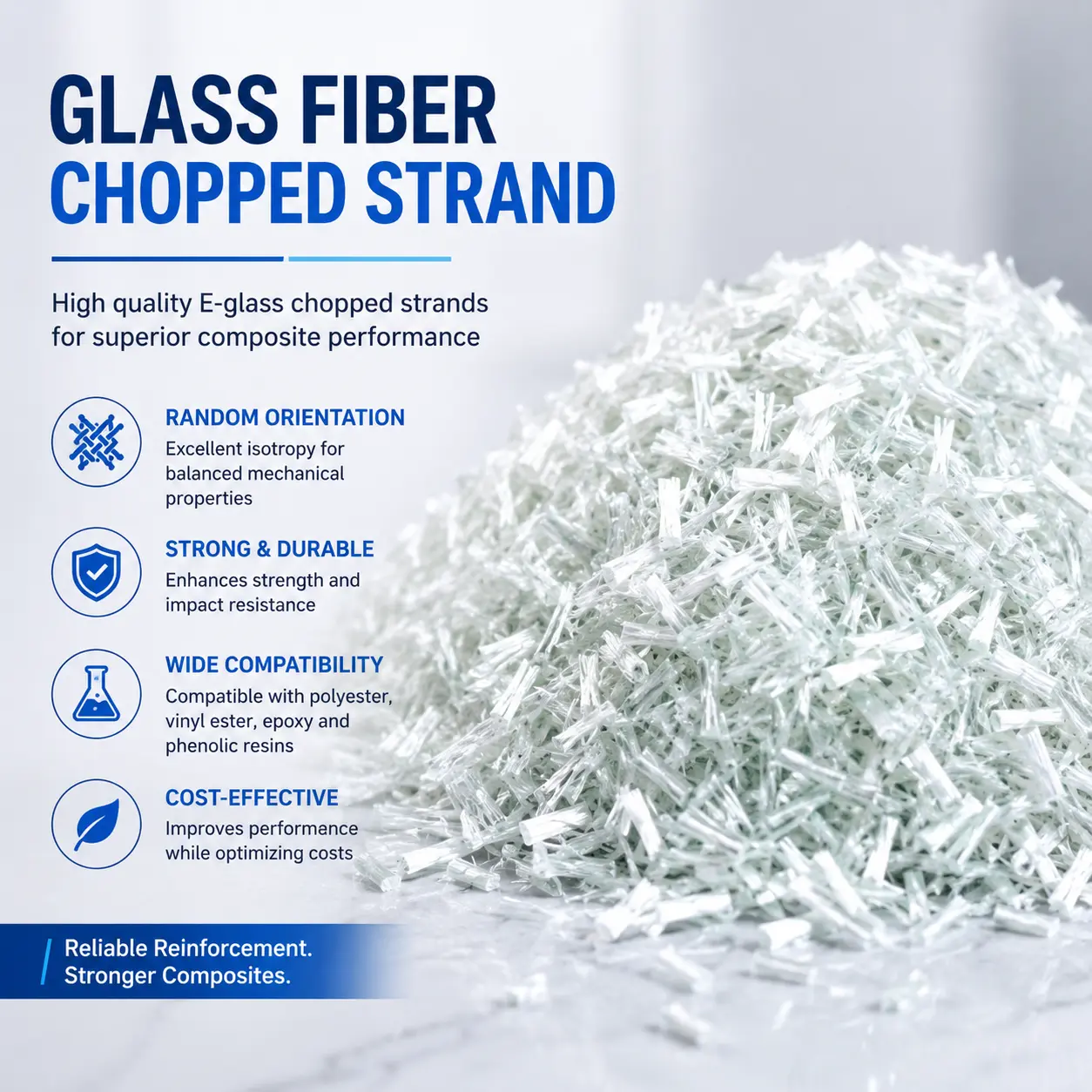
Chopped glass strands for thermoplastics are short E-glass strands with surface sizing designed to reinforce polymers such as PP, PA6, PA66, PBT and PET. They are commonly compounded using a twin-screw extruder into glass-filled pellets for injection molding. Correct sizing compatibility matters more than choosing on cut length or unit price alone.
What are thermoplastic chopped strands?
These are loose, cut glass strands, not binder-bonded chopped strand mat (CSM). A suitable compound grade must feed and disperse reliably while bonding to the actual polymer matrix. Common nominal lengths include 3, 4.5 and 6 mm, with filament diameters sometimes around 10–13 µm, depending on grade. These are indicative values, not universal specifications.
PP, PA6, PA66, PBT and PET applications
PP – Polypropylene
Glass-filled PP is used for molded industrial, appliance and automotive parts where improved stiffness, tensile performance and dimensional stability are needed. Use polyolefin-compatible sizing and assess coupling additives such as PP-g-MA where required.
PA6 and PA66 – Polyamides
PA6-GF and PA66-GF compounds are common in engineered housings and mechanically loaded components. Evaluate moisture conditioning, processing temperature, residual fiber length and hydrolysis resistance for the final service environment.
PBT and PET – Thermoplastic polyesters
Glass-reinforced PBT/PET can serve connectors, electrical housings and precision parts. Proper resin drying and moisture control are essential to prevent processing-related degradation.
Should you choose 3, 4.5 or 6 mm?
3 mm: may suit feeding and dispersion requirements. 4.5 mm: is often assessed for balancing reinforcement with processing. 6 mm: may be suitable for particular equipment and grades, but requires trials. Longer incoming strands do not necessarily mean stronger molded parts: shear in compounding and injection molding reduces fiber length.
Typical glass-fiber compounding process
- Specify polymer, glass grade, additives and target glass content.
- Dry feedstocks according to grade recommendations.
- Melt the polymer and add glass at a suitable extruder location, often a side feeder.
- Optimize screw design and speed to limit fiber breakage while achieving dispersion.
- Pelletize, then validate glass content and mechanical performance.
PP-GF20, PA6-GF30 and PBT-GF30, for example, describe nominal glass weight percentages, not universally optimal recipes.
Purchasing and qualification checklist
- Documented sizing compatibility with the specific PP, PA or polyester grade.
- Cut length, filament diameter, moisture and bulk density from current TDS.
- Stable feeding, low fuzz and dispersion on actual production equipment.
- Residual fiber length, mechanical properties, shrinkage and warpage validation.
- Lot traceability, COA and consistency over production batches.
Do not directly substitute BMC/SMC grades. Thermoset-oriented sizing can differ substantially even for identical nominal fiber dimensions.
Get technical support from GKFRP / GKTECH
Share polymer type, target glass percentage, processing method, monthly consumption and required part performance. GKFRP can help identify a candidate grade and a practical validation plan.
Frequently asked questions
Can PP chopped strands be used for PA6?
Not without compatibility verification. Sizing chemistry needs to suit the specific resin.
Is 4.5 mm always better than 3 mm?
No. Compare feedability, dispersion and retained fiber length after compounding on your actual equipment.
Are chopped strands the same as CSM?
No. Loose chopped strands and binder-bonded mats are different reinforcement products.