
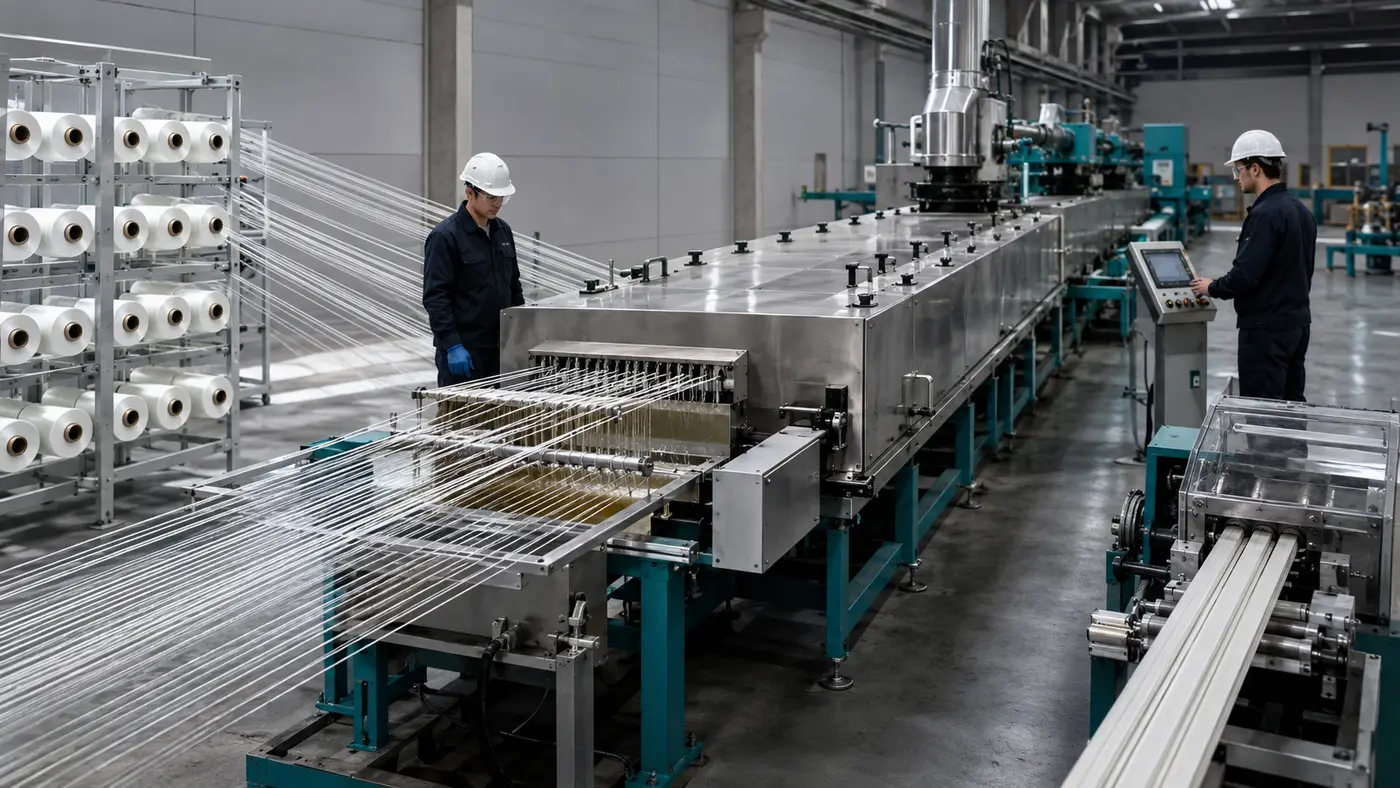
Continuous reinforcement controls strength
Direct roving provides longitudinal strength; mat or veil can add transverse performance and surface quality.
Match the resin system to line speed
Viscosity, fibre wet-out, cure response and exotherm must be balanced with die design and pulling speed.
Control friction and release
Internal release, die condition and die temperature affect pulling force, profile surface and production stability.
How pultrusion works
Continuous reinforcement (direct roving, plus mat or veil where needed) is pulled through a resin bath or injection chamber to wet out, then through a heated die where the profile is shaped and cured. A puller downstream keeps line speed constant and the cured profile is cut to length. Because the process is continuous, any change in fiber, resin or die temperature immediately affects the whole batch.
Typical pultruded products
Round rods and tubes, I, U and L sections, FRP grating, insulating ladders, FRP rebar for concrete, profiles for lightweight structures and corrosion-resistant construction.
Common defects and what to check
- Rising pull force or sticking: check internal release, die zone temperatures and die cleanliness.
- Dry fiber or exposed fiber on the surface: check resin viscosity, fiber tension and wet-out time.
- Longitudinal cracks or blisters: check catalyst level, die temperature and line speed.
- Unstable dimensions: check roving count and die wear.