
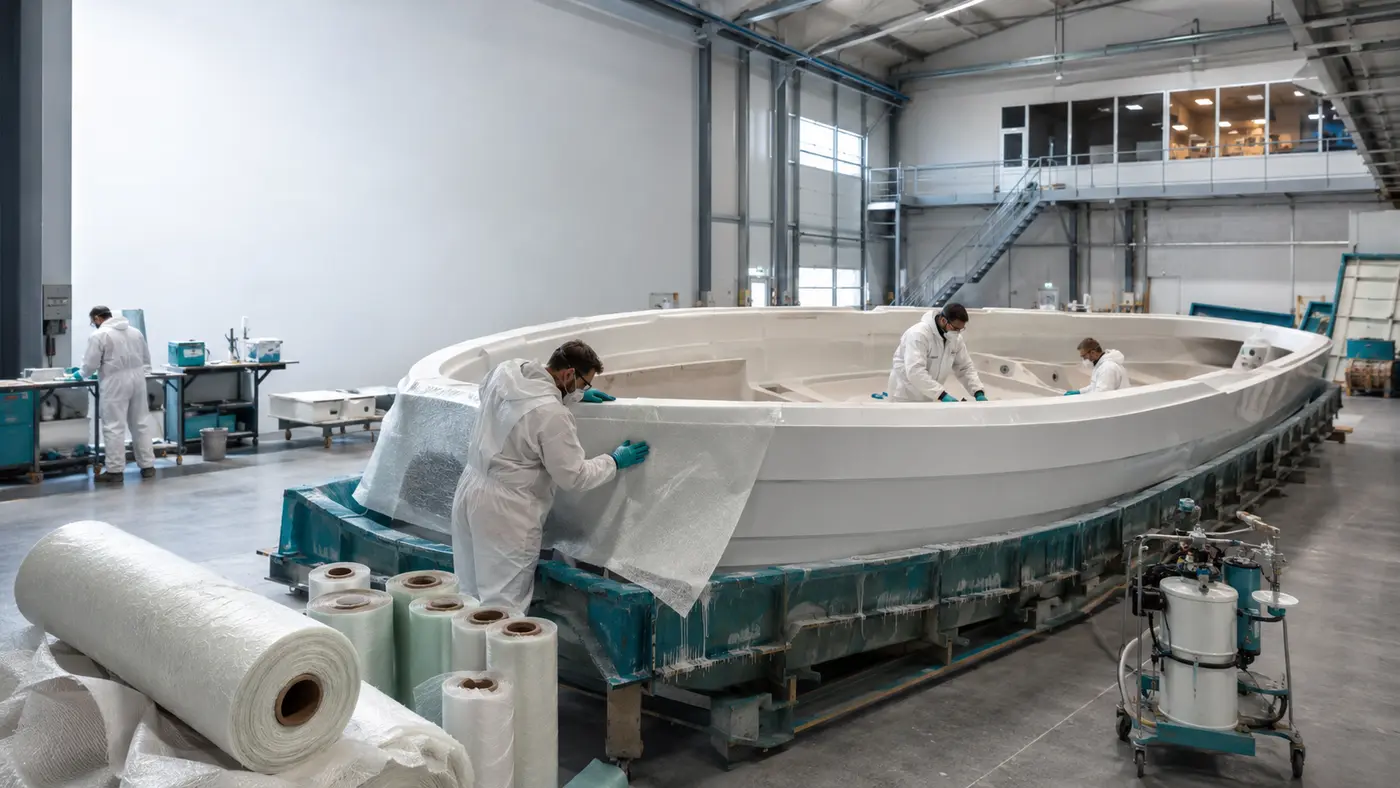
Why composites are used in boatbuilding
FRP composites offer a useful combination of low weight, corrosion resistance and shape flexibility. Hull shells, decks, cabins and structural details can be molded into large integrated parts, reducing joints and simplifying complex geometry.
Durability depends on more than the fiber and resin name. Laminate quality, resin-to-fiber ratio, surface protection, core design, edge sealing and local load introduction all influence long-term performance under moisture, vibration and cyclic loading.
Choosing the resin system
Polyester
Unsaturated polyester is widely used for general marine FRP production because it is practical to process and cost-effective. Grade selection should consider viscosity, gel time, wet-out, mechanical requirements and service environment.
Vinyl ester
Vinyl ester is often selected when improved moisture, chemical or mechanical performance is required compared with general-purpose polyester systems.
Epoxy
Epoxy is appropriate where high adhesion, high fiber content, sandwich bonding or high-performance reinforcement such as carbon fiber is required.
Gelcoat and the marine surface
Gelcoat provides the cosmetic and environmental surface for many marine FRP parts. Film thickness, catalyst level, mold condition and laminate timing should be controlled to reduce pinholes, cracking, print-through, blistering and weak adhesion.
Reinforcement follows load direction
CSM is useful for conformability and general reinforcement, woven roving can build thickness efficiently, multiaxial fabrics align fibers with principal loads, and carbon fiber may be introduced where high specific stiffness or lower weight is required.
Reinforcement should not be selected by gsm alone. Fiber architecture, orientation, drape, wet-out and resin compatibility determine the actual laminate efficiency.
Sandwich construction and core materials
PVC foam, PET foam, balsa and honeycomb can increase panel stiffness without a proportional increase in mass. The correct core depends on compressive and shear requirements, thermal capability, machinability, resin uptake and the manufacturing process.
Engine mounts, hinges, cleats and other concentrated-load areas generally need inserts, high-density core, potting or local reinforcement instead of transferring load directly into low-density core. Core edges should also be sealed against water ingress.
Hand lay-up, vacuum bagging and infusion
| Process | Main benefit | Key controls |
|---|---|---|
| Hand lay-up | Flexible and economical for large tools and lower volumes | Resin/fiber ratio, trapped air, laminate uniformity |
| Vacuum bagging | Improves consolidation and helps remove air | Bag sealing, peel ply, release film, breather and vacuum level |
| Vacuum infusion | Better resin control and more consistent laminate potential | Flow design, permeability, leak tightness and gel time |
Common production defects
- Air voids and dry spots from incomplete wet-out or consolidation.
- Resin-rich areas that add weight and cure shrinkage.
- Print-through from reinforcement or core.
- Delamination at skin-to-core or secondary bonds.
- Core crush under excessive vacuum or concentrated load.
- Water ingress through unsealed core edges, holes or inserts.
- Warping from uneven cure or unbalanced laminates.
Material-system checklist
- Define loads, stiffness and target mass by structural zone.
- Select resin according to environment, performance and shop process.
- Select reinforcement according to load direction, not areal weight alone.
- Define core, inserts and edge close-outs before production.
- Confirm compatibility between resin, reinforcement, core, adhesive and consumables.
- Review the current TDS for each exact grade before design release.