
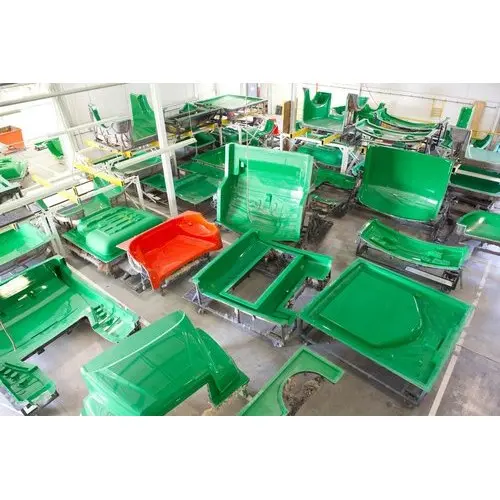
Resin Transfer Molding (RTM) is a closed-mold process that uses two rigid mold halves. A shaped dry-fiber preform is placed in the cavity, the mold is closed and clamped, and a suitable low-viscosity resin is injected through one or more inlet ports. Air exits through strategically positioned vents while resin fills the preform. After cure, the mold is opened to produce a part with controlled geometry, thickness and surface finish on both sides.
How RTM differs from vacuum infusion
Both processes introduce resin into dry reinforcement, but RTM uses two rigid mold surfaces and generally delivers resin under controlled injection pressure. Vacuum infusion uses one rigid mold surface and a flexible vacuum bag, with resin flow driven mainly by vacuum pressure differential. The matched mold gives RTM greater control over part geometry, thickness and two-sided surface quality, and it can support more repeatable cycle times. The trade-off is higher tooling cost, more demanding clamping requirements and tighter process control.
Main elements of an RTM system
A basic RTM cell includes upper and lower mold halves, a clamping system, resin inlet ports, air vents, seals and metering–injection equipment. Depending on the application, it may also include heated tooling, vacuum assistance, pressure sensors or flow-front monitoring. The mold must remain dimensionally stable under injection pressure and clamp load while incorporating a suitable parting line, draft angles and seal arrangement for consistent demolding.
Preform and reinforcement preparation
Glass fiber, carbon fiber or other reinforcement is cut, stacked and shaped into a preform before mold closure. The preform must stay in position as resin begins to flow and provide sufficiently uniform permeability to avoid dry regions. Compatible binders or forming aids may be used, but their effect on resin flow and laminate performance must be validated. Variation in fiber mass or preform thickness changes permeability, fill pressure and the final fiber-to-resin ratio.
Selecting a resin for RTM
The resin must maintain sufficiently low viscosity during injection, provide enough working time to fill the cavity and cure within the required production cycle. Polyester, vinyl ester and epoxy systems can all be used when formulated for resin-transfer processing. Selection should consider viscosity as a function of temperature, gel time, exotherm, shrinkage, mechanical requirements and compatibility with catalysts, reinforcement, preform binder and the mold-release system.
Raising temperature to reduce viscosity cannot be considered in isolation because it also shortens the processing window. Resin temperature, mold temperature and mixed mass must be controlled together to prevent premature reaction in the injection equipment or incomplete mold filling.
Inlet and vent design
Inlet location determines the direction of the resin flow front, while vents must release air from the areas that fill last. Poor placement can allow resin to race along the parting line or mold edge, surround a pocket of air and create a defect. Large or complex parts may require evaluation of several inlet–vent arrangements, flow simulation where justified, and confirmation through trials in the actual mold.
Injection pressure should not be copied from a generic value. The allowable level depends on mold stiffness, clamp capacity, preform permeability, resin viscosity and projected part area. More pressure may shorten fill time, but it can also distort the mold, open the parting line or move the reinforcement.
Basic RTM production cycle
Before each cycle, the mold is cleaned, inspected and treated with the specified release system according to the maintenance plan. The preform and any inserts are positioned, then the mold is closed and clamped to the validated load. Mold sealing must be checked before injection; when vacuum assistance is used, stable vacuum should be confirmed.
Resin is metered, mixed and injected at the established flow rate or pressure. Resin arrival at each vent, cavity pressure and fill time should be monitored for abnormal behavior. Once the cavity is full, lines are closed in the validated sequence and the required temperature and pressure conditions are maintained through gel and cure. The mold is then opened, the part removed and trimmed, and the finished component inspected.
Common defects and likely causes
Dry spots may result from an overly compacted preform, a blocked flow path, high resin viscosity or insufficient processing time. Voids can be caused by seal leakage, inadequate venting, air introduced during mixing or a flow front that encloses trapped air. Race tracking commonly occurs along mold edges, around inserts or where the preform does not contact the cavity uniformly. Dimensional distortion and heavy flash may indicate injection pressure above the tool capability or insufficient clamp force.
Effective troubleshooting requires recording resin and mold temperatures, mix ratio, injection time, flow rate or pressure, vent-closing sequence, gel time and defect location for each cycle. This data helps separate material-related problems from mold-design or operating errors.
When is RTM the right process?
RTM is a strong option when the product requires controlled surfaces on both sides, consistent thickness, repeatable geometry and higher output than hand lay-up or vacuum bagging. Typical candidates include transportation components, equipment housings, industrial parts and structures requiring controlled fiber and resin content. The business case depends on production volume being sufficient to justify tooling and equipment, along with cycle time, scrap rate and the selected level of automation.