
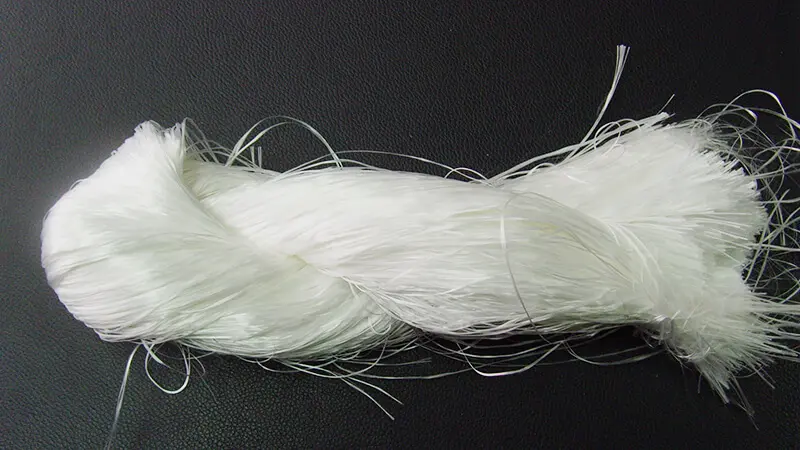
What is Premix GRC?
GRC/GFRC is a cementitious composite reinforced with alkali-resistant glass fiber. In the premix process, AR fiber is incorporated into the prepared matrix and distributed throughout the material before forming. This differs from spray-up, where mortar and chopped fiber are deposited together onto the mold surface.
Premix is well suited to molded parts, complex geometries, architectural elements, thin components and applications where reinforcement is required through the full section.
1. Select the correct alkali-resistant AR glass fiber
Cement-based matrices are highly alkaline, so reinforcement should be a glass fiber specifically intended for cementitious service. Conventional E-glass should not be substituted unless the manufacturer explicitly confirms suitability for long-term alkaline exposure.
Fiber length, sizing and product form all influence dispersion, mix viscosity and the tendency to form fiber balls. When process data is not yet established, the current TDS for the specific fiber grade should take priority over generic rules of thumb.
2. Prepare the cementitious matrix and control water addition
A premix matrix typically combines cement, fine aggregate or suitable filler, water and process additives according to the formulation. The goal is enough flow for mold filling while maintaining stable fiber suspension.
Excess water may improve apparent flow but can increase segregation, shrinkage and surface defects. A mix that is too dry can make fiber dispersion difficult and increase trapped air. Flow should therefore be managed through formulation and suitable additives rather than by uncontrolled water addition.
3. Mixing sequence has a major effect on fiber dispersion
A stable process normally begins by creating a uniform cementitious matrix before introducing AR fiber at the appropriate stage. Fiber should be added progressively to reduce local overloading and minimize balling.
Once dispersion is achieved, unnecessary high-shear mixing should be avoided because it can reduce effective fiber length and entrain additional air. Mixing time and speed should be established on the actual production mixer rather than copied from a different setup.
4. Control rheology: enough flow without segregation
Premix GRC requires a balance between flow and fiber-holding capability. The material must fill the mold and reach corners while avoiding fiber flotation, settlement, localized alignment or water separation.
Changing fiber content, fiber length, filler or admixture can significantly alter rheology. Flow should be rechecked whenever the formulation changes rather than assuming that the original mixing time remains valid.
5. Casting and vibration
After mixing, material should be placed within the available working time. For molds with ribs, deep corners or decorative surfaces, the filling strategy should minimize unnecessarily long flow paths because strong flow can create local fiber orientation.
Vibration or compaction can improve mold filling and release trapped air, but excessive vibration may promote segregation. The target is the minimum effective compaction required to achieve a dense, well-filled part.
6. Curing controls strength and dimensional stability
After forming, the material needs suitable curing conditions so cement hydration can proceed consistently. Early moisture loss can increase shrinkage cracking, reduce surface quality and interfere with strength development.
Temperature, humidity and demolding time should be controlled according to the formulation and part geometry. Thin sections are especially sensitive to moisture loss and distortion during the early curing stage.
7. Common defects and what to check
- Fiber balling: check feed rate, mixing sequence, matrix viscosity and sizing compatibility.
- Segregation or floating fiber: review water content, flow, vibration level and delay before casting.
- Air voids: check filling method, vibration and air entrainment during mixing.
- Early cracking or warpage: review moisture loss, premature demolding and curing conditions.
- Variable mechanical performance: check fiber distribution, batch consistency and curing repeatability.
8. Premix versus spray-up
Premix is convenient for molded shapes and for distributing reinforcement throughout the full section. Spray-up is often better suited to larger surfaces or laminates where reinforcement build-up through the thickness needs to be controlled during deposition. Neither method universally replaces the other; the correct choice depends on geometry, equipment, throughput and mechanical requirements.
Production checklist
- Confirm the correct AR glass grade for cementitious use.
- Verify fiber length and dispersion on the actual mixer.
- Standardize water and admixture addition; avoid uncontrolled water adjustment on the shop floor.
- Define an acceptable flow range and working time.
- Set the minimum effective vibration/compaction level.
- Standardize curing conditions and demolding time.
- Cross-check operating parameters against the current material TDS.