
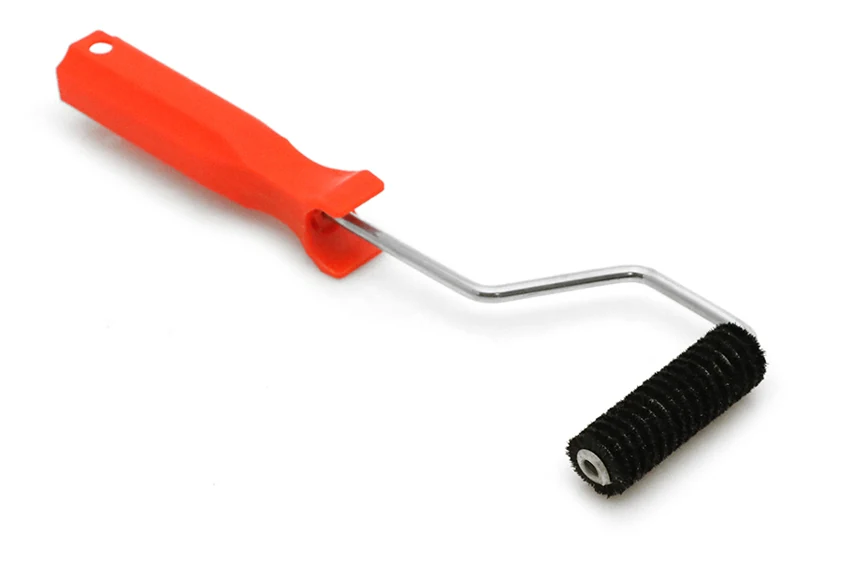
What is a nylon bristle roller?
The roller head is formed from multiple rings of stiff nylon bristles arranged along the shaft. During hand lay-up, it is used after fiberglass reinforcement has been wetted with resin to distribute resin, press the reinforcement toward the mold surface and help move trapped air out of the laminate.
Compared with grooved or spiral metal rollers, the bristle surface provides softer contact. This can be useful on thin reinforcement layers or in areas where excessive rolling pressure may disturb the fibers.
When is it useful?
A nylon bristle roller is particularly suitable for operations that require lighter, more flexible consolidation, including:
- Surface mat and other thin reinforcement layers.
- Curved surfaces, radiused areas and complex geometry.
- Small areas that are difficult to reach with rigid metal rollers.
- Resin distribution where fiber displacement should be minimized.
- Locations where gentle consolidation and resin control are both needed.
Why consolidation matters
Air trapped between FRP laminate layers can create voids, reduce laminate uniformity and affect surface quality. Proper rolling helps improve contact between reinforcement layers, distribute resin more evenly and reduce visible air pockets.
A bristle roller does not replace every other consolidation roller. For thicker laminates or areas requiring greater consolidation pressure, grooved aluminum rollers, spiral rollers or corner rollers may be more suitable. Selection should be based on reinforcement type, part geometry and the thickness of the layer being processed.
Practical advantages
- Flexible bristle surface follows curved and uneven areas more easily.
- Lower contact pressure is suitable for thin reinforcement layers.
- Helps spread resin and remove trapped air while reducing fiber disturbance.
- Available in different diameters and roller lengths for different part sizes.
- Can be cleaned and reused when cleaned promptly using a procedure compatible with the resin system.
Reference dimensions
| Item | Information |
|---|---|
| Roller diameter | 18 / 22 / 25 / 28 / 50 mm |
| Roller length | 50–200 mm |
| Roller material | Stiff nylon bristles |
| Handle | Plastic handle, steel frame |
These dimensions are reference ranges based on the current product information supplied by GKTECH. Actual available sizes should be confirmed when ordering.
Selecting a size
Smaller rollers are generally easier to use in tight corners, small radii and detailed molds. Longer rollers can improve productivity on wider, relatively flat surfaces. For strongly curved parts, choose a size that allows the operator to maintain even contact across the roller width.
Cleaning after use
The roller should be cleaned immediately after lamination, before resin cures in the bristles. The cleaning solvent and procedure must be compatible with the resin system and the workshop's safety requirements. Allowing resin to fully cure inside the roller reduces bristle flexibility and performance.
GKFRP support for lamination tools
GKFRP supplies composite lamination rollers including nylon bristle rollers, grooved aluminum rollers, spiral rollers and corner rollers. For selection support, provide the reinforcement type, resin system, part dimensions and mold geometry.