
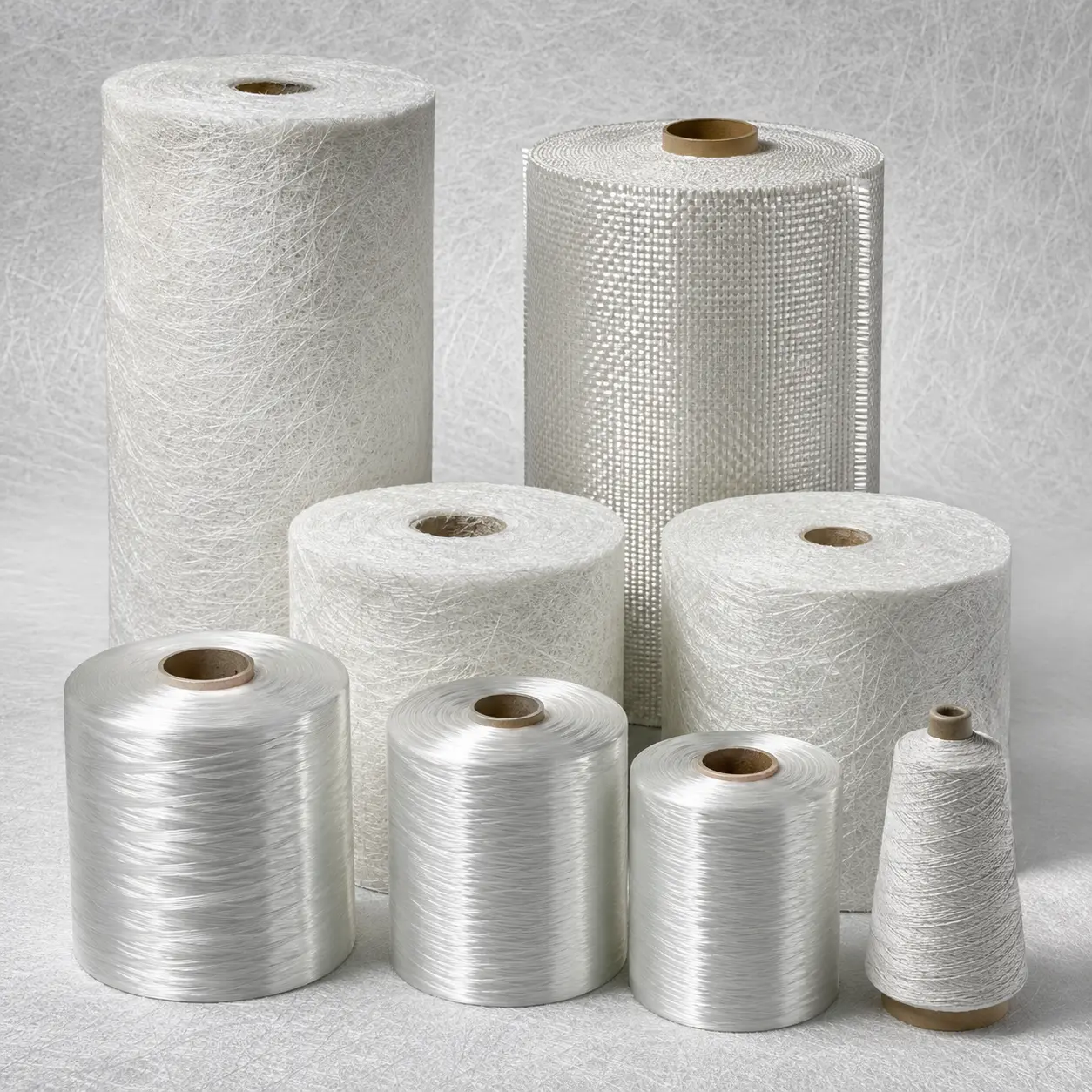
Fiberglass is the most widely used reinforcement in many composite applications because it offers a practical balance of strength, processability and cost. Fiberglass is not, however, a single product. Different fiber forms, orientations, areal weights, binders and sizings can produce very different wet-out behavior, conformability and laminate performance even when they are all based on E-glass.
What does fiberglass do in a laminate?
The resin forms the shape, transfers load and protects the structure, while the glass fibers carry much of the tensile load and strongly influence laminate stiffness. Reinforcement efficiency depends on fiber direction relative to the applied load. Continuous fibers aligned with the load are generally more efficient than random short fibers, while random reinforcement is easier to form and provides more uniform in-plane behavior.
A practical laminate often combines several architectures: mat for surface support and interlaminar transition, with woven roving or multiaxial fabric carrying loads in defined directions.
Chopped Strand Mat (CSM)
CSM consists of randomly distributed chopped strands held together by a powder or emulsion binder. It is easy to cut or tear, conforms well to molds and provides relatively uniform in-plane reinforcement. Common uses include hand lay-up, spray-up, skin coats behind gelcoat and interlayers between woven reinforcements to reduce print-through and improve layer integration.
Selection should consider binder type, wet-through, wet-out speed and areal weight. Many mats are designed primarily for polyester or vinyl ester resin, so not every CSM should be assumed compatible with epoxy. For epoxy processing, use a mat specifically confirmed by the manufacturer or a stitched construction that does not depend on a styrene-soluble binder.
Woven roving
Woven roving is made from large roving bundles woven in the 0° and 90° directions. It builds thickness rapidly, can achieve a higher fiber fraction than CSM and is widely used in tanks, boats, panels, pipes and industrial FRP structures. Large bundles and weave crossovers can create a coarse surface, resin-rich zones and limited drape around tight radii.
Woven roving is commonly combined with CSM or a surface layer rather than placed directly behind gelcoat. Thorough consolidation is required to wet the full bundle and remove air, particularly with heavy fabrics or higher-viscosity resin.
Woven fiberglass fabrics
Woven fabrics use finer yarns or rovings and may have plain, twill or satin weave patterns. They provide a smoother finish and better control of fiber orientation for thin parts, cosmetic layers and performance laminates. Plain weave offers good dimensional stability but lower drape; twill and satin usually conform more readily to curved shapes but require control to prevent fiber distortion during lay-up.
Biaxial and multiaxial fabrics
Biaxial and multiaxial reinforcements contain nearly straight fiber layers oriented at 0°/90°, +45°/−45° or several combined directions and held together by stitching. Reduced fiber crimp can improve load transfer in the designed directions. These fabrics are common in marine structures, wind energy, large panels and parts requiring controlled stiffness.
For infusion, through-thickness permeability, stitch pattern and nesting between layers must be assessed. Good in-plane resin flow does not automatically mean that a thick stack will wet through effectively.
Direct roving and assembled roving
Direct roving is a continuous bundle wound directly from the bushing and is typically engineered for filament winding, pultrusion, weaving or another defined process. Assembled roving combines multiple strands and is commonly used for spray-up, SMC, GMT or selected textile products. Products with the same tex can still differ in filament design, fuzz, payout tension, choppability and wet-out.
The grade must therefore match the process. Winding roving needs stable tension and rapid impregnation; pultrusion roving must run continuously with low fuzz at the required line speed; spray-up roving must chop, disperse and wet out consistently after application.
Chopped strands and specialized forms
Chopped strands are loose fibers cut to a controlled length for thermoplastics, BMC, SMC, concrete, gypsum or other dispersed systems depending on sizing. Surface veils provide a smooth, resin-rich corrosion barrier and mask coarser reinforcement below. Continuous filament mats and stitched combination mats support processes requiring specific permeability, forming behavior or productivity.
Why binder and sizing matter
Binder holds a mat together; sizing is a very thin surface treatment applied to the filaments to protect them during processing and promote bonding with the resin. Sizing affects fuzz, chopping, wet-out speed, interfacial adhesion and final mechanical performance. A reinforcement can have the right architecture and weight but still process poorly if its sizing is incompatible.
When changing manufacturer or grade, confirm compatibility with the polyester, vinyl ester, epoxy, polyurethane or thermoplastic matrix in use. A generic product name and price per kilogram are not sufficient selection criteria.
Selecting for the manufacturing process
Hand lay-up needs rapid wet-out, easy air release and good conformability. Spray-up requires stable chopping and uniform strand dispersion. Vacuum infusion needs permeability that matches the resin-flow strategy. RTM requires a stable preform with controlled permeability. Pultrusion, filament winding and SMC/BMC each require roving or chopped strands engineered for the equipment and resin system.
Heavy reinforcement builds thickness quickly but may be harder to drape and wet. Lower areal weight improves forming and surface quality but increases ply count and labor. Selection must balance part quality, production speed and total laminate cost.
Validation before freezing the BOM
Start with structural loads and directions, target thickness, surface requirements, resin system, manufacturing method and cycle time. Build a representative trial laminate and measure resin consumption, wet-out time, air release, actual thickness and fiber-to-resin ratio. Structural parts should be tested using representative laminates rather than relying only on nominal fiber data.
When changing material, vary one factor at a time and record lot number, storage conditions and processing data. This is the most reliable way to prevent small changes in sizing or architecture from becoming a production-wide defect.