
What is Continuous Filament Mat?
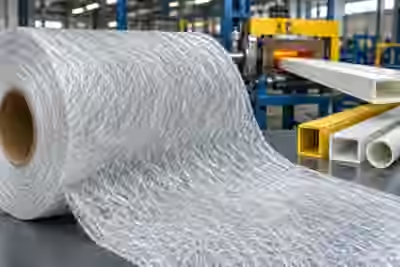
Continuous Filament Mat (CFM), also called Continuous Strand Mat, is a fiberglass reinforcement made of continuous glass filaments distributed in multiple directions and bonded with a compatible binder. Unlike chopped strand mat made from cut fibers, CFM contains a network of continuous strands. For pultrusion, select a grade designed to withstand continuous feeding and forming.
Why combine CFM with direct roving?
Direct roving runs predominantly along the pulling direction and provides most of the longitudinal stiffness and strength. CFM adds glass filaments in other orientations, supporting transverse properties and laminate integrity. The magnitude of improvement depends on reinforcement architecture, fiber content, resin impregnation and curing.
CFM does not replace longitudinal roving. A separate surface veil can be considered when a particularly smooth finish is needed.
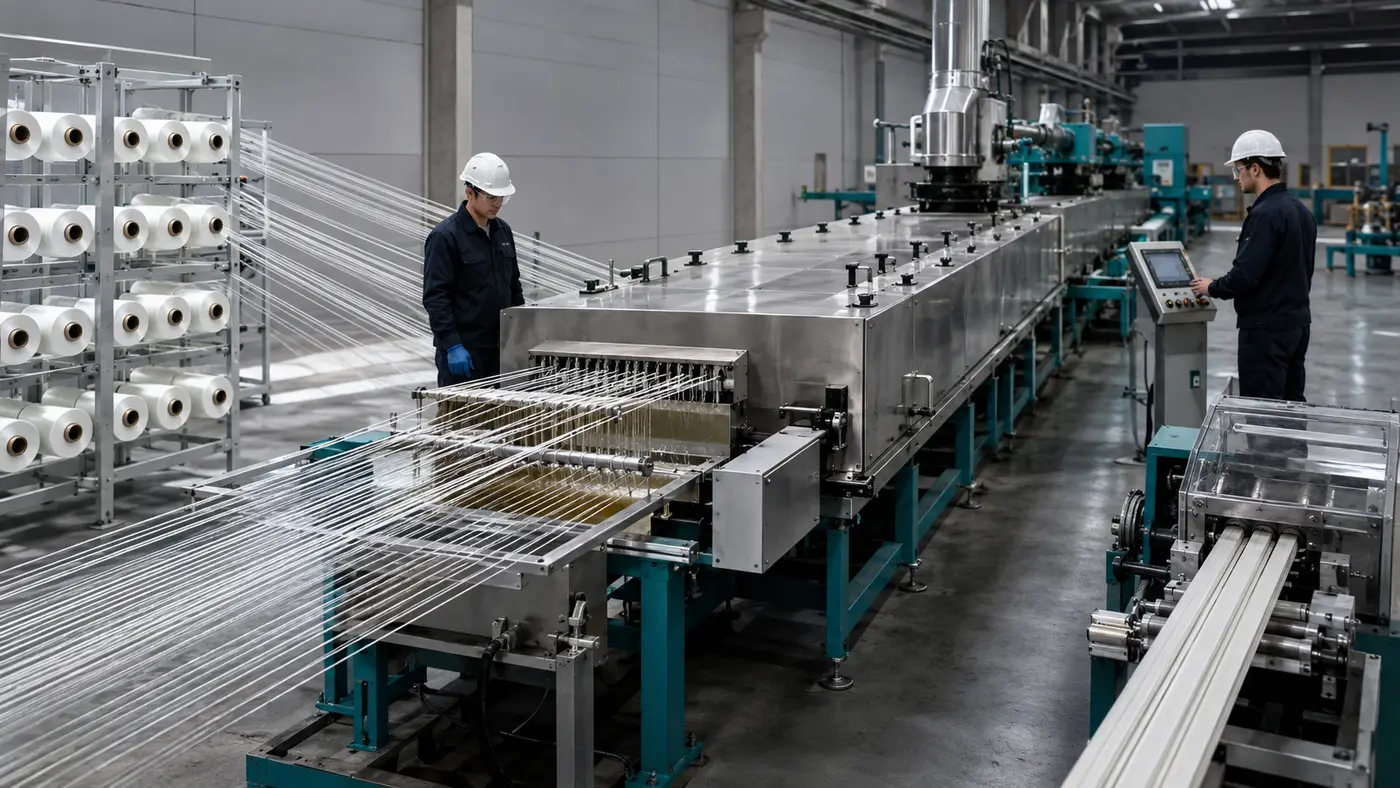
Pultrusion process with CFM
- Reinforcement feeding: feed CFM rolls and direct roving according to the laminate design, controlling path alignment and tension.
- Resin impregnation: pass materials through a resin bath or injection chamber, ensuring adequate wet-out and air release.
- Preforming: progressively shape the wet reinforcement through guides without tearing, wrinkles or fiber bunching.
- Heated die: pull through the die while the thermoset resin cures at controlled temperatures.
- Pulling and cutting: cut the continuous profile to length; check dimensions, surface appearance and cure.
Selecting a resin system
Unsaturated polyester, vinyl ester and epoxy may be suitable if the CFM binder and sizing are compatible with the selected resin. Confirm with the manufacturer's technical data sheet and processing trials. Resin viscosity, gel time, die temperature and pulling speed must be optimized together rather than applying a universal setting.
Key technical selection parameters
| Parameter | Why it matters |
|---|---|
| Areal weight (g/m²) | Influences reinforcement amount and laminate build |
| Mat tensile strength | Supports continuous feeding without tearing |
| Resin wet-out | Helps minimize dry zones and voids |
| Binder and sizing | Must be compatible with the resin system |
| Conformability | Helps follow corners and complex profiles |
| Roll width and length | Must fit feeding equipment and production requirements |
Important: Specific weights, widths and other values must be verified from the actual product TDS. General descriptions are not a guarantee of GKTECH product specifications.
Common pultruded FRP applications
- U-, I- and H-shaped structural FRP profiles
- Square and rectangular hollow sections
- FRP cable trays, handrails and guardrail components
- Cooling tower members and industrial composite profiles
Troubleshooting common problems
- Mat tearing: inspect tension, guide rollers, friction and the selected mat grade.
- Dry fiber zones: check resin viscosity, impregnation, venting and layer arrangement.
- Wrinkles or bunching: adjust the preformer layout and mat entry path.
- Uneven surface: review roving distribution, mat positioning, surface veil and curing conditions.
Contact GKTECH for material selection
GKTECH can discuss the appropriate fiberglass reinforcement based on your profile drawing, wall thickness, resin system and mechanical requirements. Contact us to review the application and arrange suitable material trials.
Request technical advice / quotation Explore reinforcement materials
Email: gktech@gktech.vn