
Select resin for the chemical environment
Chemical concentration, operating temperature and exposure time determine whether polyester, vinyl ester or a specialised resin system is required.
Design corrosion barrier and structural layers
The barrier layer needs a resin-rich surface and suitable reinforcement; structural layers are engineered for load, size and installation conditions.
Control processing and cure
Catalyst ratio, temperature, humidity, gel time and post-cure must follow the TDS and actual production conditions.
The corrosion-resistant laminate
Design standards such as ASTM D3299 (filament-wound tanks), ASTM D4097 (contact-molded tanks) and BS 4994 divide an FRP wall into two functional zones:
- Corrosion barrier: the resin-rich layer in direct contact with the chemical, typically 2.5–3 mm thick, reinforced with surfacing veil and chopped strand mat. It decides the chemical resistance of the whole vessel.
- Structural layer: the load-bearing wall outside the barrier, reinforced with woven roving, multiaxial fabric or continuous filament winding, carrying pressure, loads and stiffness.
Resin systems
Resin selection depends on the chemical, its concentration, the operating temperature and thermal or load cycling.
- Isophthalic polyester: better corrosion resistance than orthophthalic grades; suitable for dilute acids, salts, wastewater and mild chemicals at moderate temperature.
- Bisphenol-A epoxy vinyl ester: the workhorse for industrial corrosion service; resists acids, alkalis, oxidizing solutions and many solvents at higher temperatures than polyester.
- Novolac vinyl ester: for severe service such as high temperature, solvents, concentrated acids and strong oxidizers.
- Fire-retardant vinyl ester: brominated or ATH-filled systems for equipment with fire requirements.
- Epoxy: resists alkalis and many solvents with high adhesion and mechanical properties; common in pressure pipe.
- Phenolic: for fire, low smoke and property retention at high temperature, e.g. chemical ventilation ducting.
Reinforcement by position
- Surfacing veil: C-glass veil, or polyester / ECTFE synthetic veil where glass is attacked; creates a resin-rich surface of roughly 10–20% fiber.
- Chopped strand mat: used behind the veil in the corrosion barrier and between woven roving plies; common weights 300, 450 and 600 g/m².
- Woven roving and multiaxial fabrics: main load-bearing reinforcement of the structural wall.
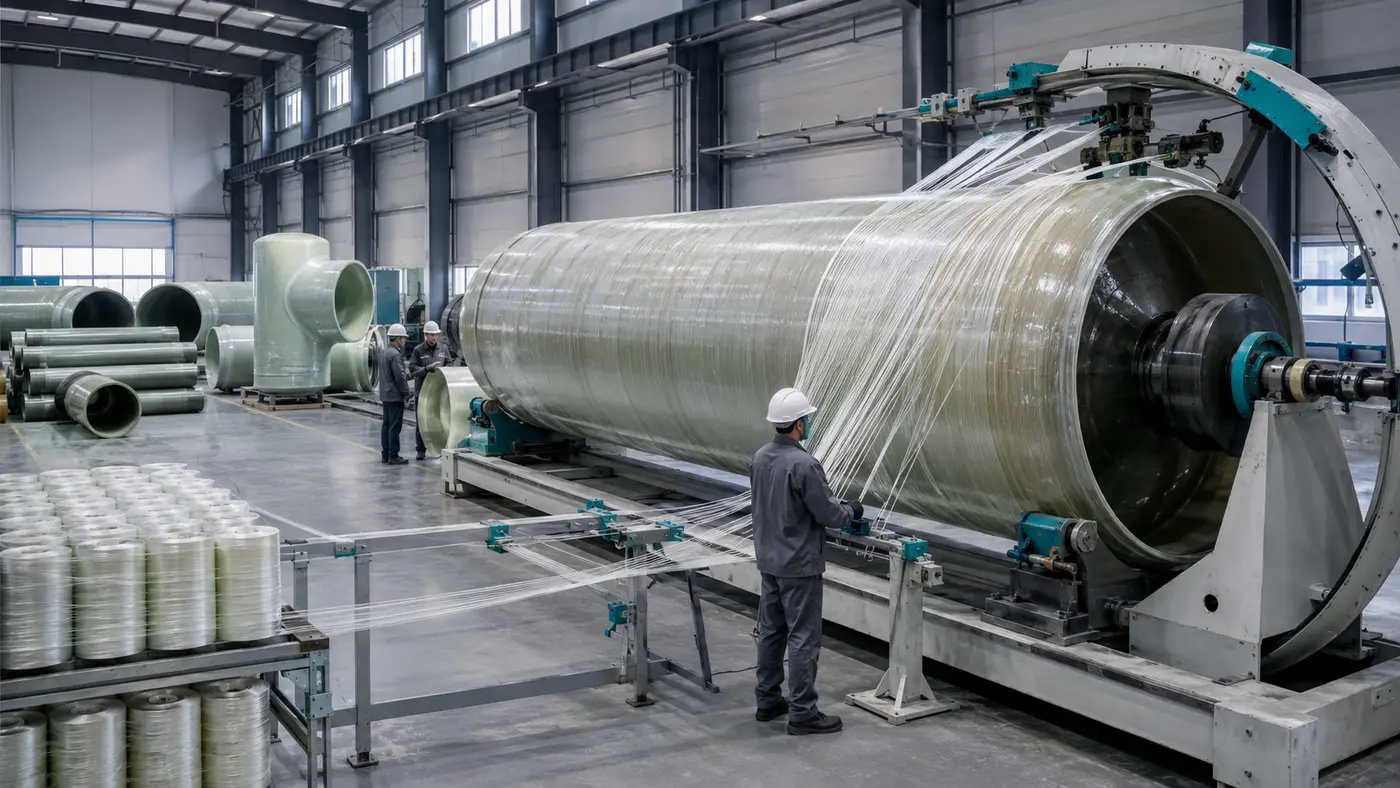
- Continuous roving: for filament winding of tanks and pressure pipe; winding angle follows the hoop-to-axial stress ratio.
- E-glass or ECR-glass: ECR-glass is boron-free with better acid resistance and less stress-corrosion cracking; recommended for direct chemical contact where conditions require.
Materials by laminate position
| Position | Function | Typical resin | Reinforcement |
|---|---|---|---|
| Surface / corrosion barrier | Chemical barrier | Vinyl ester, epoxy, phenolic | C-glass or synthetic veil + CSM |
| Transition layer | Bond between layers | Same as main resin | CSM |
| Structural wall | Load and pressure | Vinyl ester, isophthalic polyester, epoxy | Woven roving, multiaxial, continuous roving |
| Outer topcoat | Finish, UV protection | Wax-containing topcoat | — |
Process materials
MEKP catalyst and cobalt accelerator control gel time and degree of cure; wax-containing topcoats give a tack-free outer surface; mold release, cleaning solvents and resin additives (anti-sag, air release, UV) complete the system. Missing or wrong process materials are a common cause of defects even when resin and reinforcement are correct. Always check the resin manufacturer's chemical-resistance guide for the exact concentration and temperature.